Ontario’s Premier: Canada Should Be Ready to Cut Electricity, Critical Minerals as Trade Woes Worsen
- Published In: Politics
- Last Updated: Aug 24, 2026
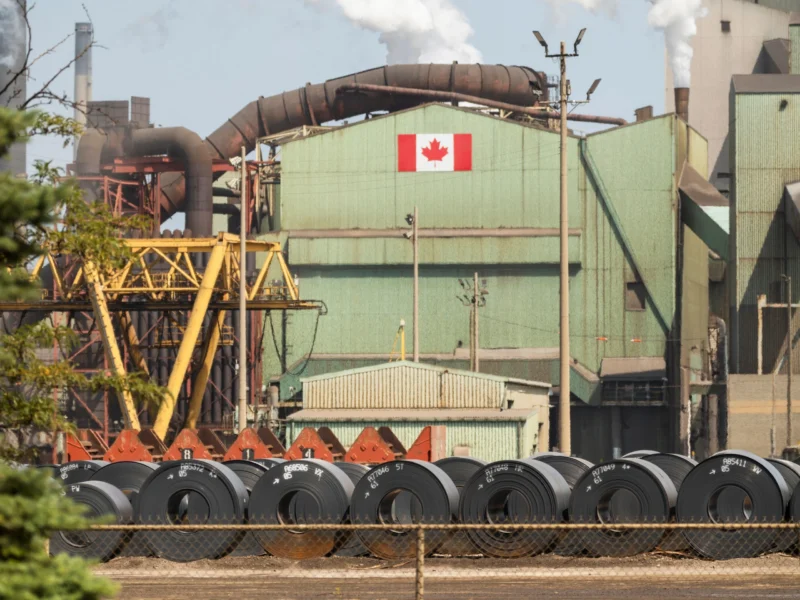
Rolled coils of steel sit in the yard at the ArcelorMittal Dofasco steel plant in Hamilton, Ont. on Thursday, Aug. 20, 2026. (Nick Iwanyshyn /The Canadian Press via AP)
By ROB GILLIES
TORONTO (AP) — Ontario Premier Doug Ford said Monday that Ronald Reagan would be “throwing up” over President Donald Trump’s trade policies and threatened to cut off electricity and critical minerals to the United States as Trump escalated the trade fight.
Ford, speaking in an interview with The Associated Press, said Trump has underestimated Canadians’ willingness to endure economic pain rather than give in to U.S. pressure.
“He underestimates Canada. We’re all in,” Ford said. “Up here, we’re at a fever pitch, everyone’s in for an economic war. They know they’re going to have to sacrifice.”
Trump said Monday that the new 50% tariffs on Canadian automobiles, auto parts and steel would begin next year.
“Canada has been ripping off the United States of America for years,” Trump wrote on social media, criticizing what he called Canada’s “ridiculously high tariffs” on American farmers.
In the AP interview, Ford said Trump had “declared war, economic war against his closest friend and ally” before invoking Reagan, whose opposition to tariffs Ford previously featured in a television advertising campaign aimed at Americans.
Ford noted that Trump keeps a portrait of Reagan near his desk.
“He’d be throwing up on him from the picture if he knew what was going on, spinning around in his grave right now,” Ford said. “He should maybe take that picture off the wall and move it somewhere else. Because right now, Ronald Reagan would be disgusted with President Trump.”
Ford’s comments came after Prime Minister Mark Carney walked away from trade negotiations with the Trump administration late Friday, saying Washington demanded too much in exchange for tariff relief. The United States imposed 50% tariffs Saturday on about $20 billion worth of Canadian goods, while Carney announced dollar-for-dollar retaliation beginning Sept. 8.
Ford threatens critical minerals and electricity
Ford said “everything is on the table” if the dispute worsens, including cutting off electricity and critical minerals from Ontario. He also called for Canada to consider using oil and potash as leverage.
“I’ll cut them off,” Ford said of critical minerals. “You won’t get a grain of sand out of Ontario.”
Critical minerals are increasingly important to U.S. national security and manufacturing. The Pentagon has sought more secure supplies of minerals used in military aircraft, missiles, munitions and electronics as Washington tries to reduce reliance on China, which dominates the mining or processing of several strategically important minerals.
Ford specifically cited high-grade nickel shipped to the United States and uranium refined in Ontario.
“What would they do without the high-grade nickel that we ship down to the U.S.?” Ford said.
Ford said Canada should consider increasingly severe retaliation if Trump continues targeting Canadian industries, including oil and potash, while Ontario could raise electricity prices or stop sending power south.
“We power 1.5 million homes and businesses,” Ford said. “Everything’s on the table. I’ll do whatever it takes.”
If Trump continues trying to dismantle Canadian manufacturing, Ford said, “he better have a pack of batteries.”
Ford has used electricity as leverage before. During an earlier phase of the dispute, Ontario imposed a 25% surcharge on electricity exported to Michigan, Minnesota and New York. Trump responded by threatening to double tariffs on Canadian steel and aluminum before both sides backed away.
Auto industry becomes a central battleground
Ford accused Trump of seeking not simply a better trade deal but to hollow out Canadian industries and move production south.
Ford said Trump wants to make Canada a vassal state.
“He wants to bleed out every single sector and bring them down to the U.S.,” Ford said.
The auto sector is especially important to Ontario, the center of Canada’s vehicle manufacturing industry. Plants and suppliers in Ontario are tightly integrated with factories in Michigan and other U.S. states, with parts routinely crossing the border multiple times during production.
Automakers including Ford, General Motors and Stellantis operate major assembly plants in Ontario, and the wider supply chain supports tens of thousands of jobs. Trump’s new threat of a 50% tariff on Canadian vehicles and parts puts that sector directly at the center of the escalating dispute.
U.S. Trade Representative Jamieson Greer said Monday that “the only reason Canada has auto production in the first place” was because of the 1960s Auto Pact, under which Canada used access to its market to encourage vehicle production north of the border.
“If he thinks the Canadian people are going to roll over and just continue buying American-made vehicles, it’s not going to happen,” Ford said.
Ford says he opposed preliminary deal
Ford also disclosed that he had opposed the preliminary agreement Carney was considering before Canada walked away from the negotiations.
“I wasn’t supporting the deal,” Ford said.
Ford said he was unwilling to restore American liquor to Ontario store shelves as part of an agreement and had been prepared to publicly break with the proposed deal.
“I wasn’t going to put the booze back on the shelves,” Ford said. “I was ready to go out there and call a press conference … and say I’m not buckling over.”
Ford said he understood Washington had sought language late in the negotiations that would have restricted Canada’s ability to negotiate trade agreements with other countries without U.S. approval. Carney has called that demand unacceptable and a question of Canadian sovereignty.
“Who does he think he is?” Ford said of Trump. “You gotta be kidding.”
Reagan fight returns
Ford’s Reagan comments revived an earlier clash with Trump. Last year, Ontario paid for U.S. television advertisements featuring excerpts from a 1987 Reagan address warning that tariffs can provoke retaliation and trade wars.
Trump accused Ontario of misrepresenting Reagan and abruptly ended trade negotiations with Canada. Ford later agreed to pause the campaign so talks could resume.
“He doesn’t respect anyone,” Ford sad.
Yet despite the increasingly hostile rhetoric, Ford said Canada should remain willing to negotiate.
“I never believe in walking away from the table,” Ford said. “Continue negotiating and see where we go.”
___
Associated Press writer Seung Min Kim contributed from Washington.