Drug Prices have Declined Sharply, and Trump is Taking Credit. The Reason Behind the Drop is Complex
- Published In: Politics
- Last Updated: Aug 18, 2026
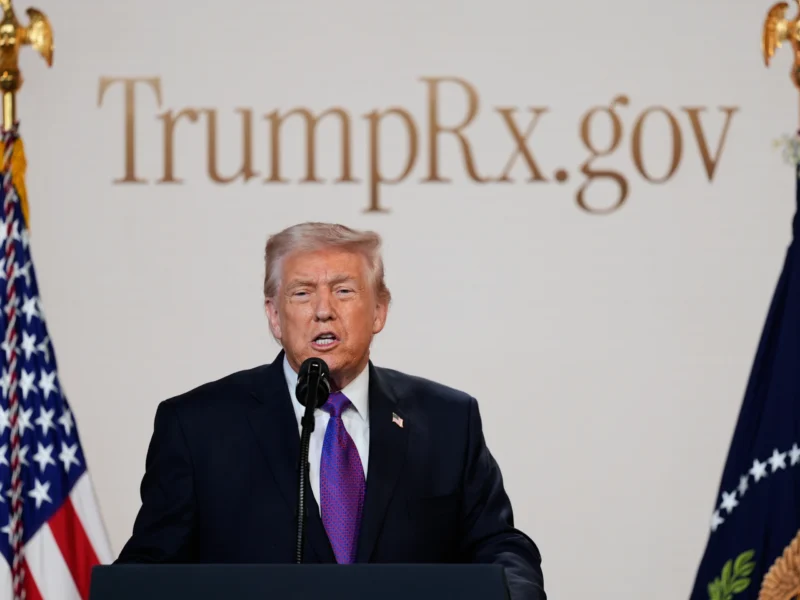
President Donald Trump speaks about TrumpRx in the South Court Auditorium in the Old Eisenhower Executive Office Building on the White House campus, Feb. 5, 2026, in Washington. (AP Photo/Alex Brandon, File)
By ALI SWENSON
NEW YORK (AP) — President Donald Trump has been taking credit for new federal data that shows U.S. prescription drug prices fell 0.8% in July and are down 3.1% from a year ago, the steepest year-over-year drop since 1963.
The plunging prices, the White House said, resulted from the Republican president’s “most favored nation” drug deals with pharmaceutical firms and the TrumpRx website, which it said are “delivering real relief to American families and putting patients first.”
The real picture is more complicated, said drug pricing experts, who noted that other factors, including a law from Democratic President Joe Biden’s time in office that allowed Medicare to negotiate with pharmaceutical companies, are potentially more significant contributors to the latest consumer price index figures.
Also at play, they said, are generic and biosimilar products that have come onto the market, offering competition that drives down the price of expensive brand-name and biologic drugs. In addition, the prescription drug price index measured by the Labor Department and released last week doesn’t directly reflect how much consumers pay — it measures how much pharmacies get paid for the drugs, both by insurers and consumers.
“It’s difficult to know in one number what’s going on beneath the hood,” said Juliette Cubanski, a vice president and director of the Program on Medicare Policy at the healthcare research nonprofit KFF. “I don’t think we can attribute this price reduction to any one specific policy change or initiative.”
Here’s what to know about the decline in prescription drug prices:
Competition and policy both contribute to changing prices
Drug pricing experts said both market competition and various policy changes have influenced prescription drug prices in recent years.
On the market side, “when big blockbuster products face generic competition, their prices fall,” said Dr. Benjamin Rome, a health policy researcher at Harvard Medical School.
For example, he said, various biosimilar drugs have arrived on the market to treat the same autoimmune conditions as the brand-name drug Humira, offering similar treatment at a lower cost.
Similarly, competition has led to price reductions for Stelara, a popular biologic medicine that treats chronic inflammatory conditions, said Stacie Dusetzina, a professor of health policy at Vanderbilt University School of Medicine.
Biden-era federal policies also likely played a role — most notably the 2022 Inflation Reduction Act, which for the first time allowed Medicare to haggle with drugmakers over the cost of the top-selling prescription drugs in the program.
New prices for the first 10 of those negotiated drugs launched in January, a change Cubanski, Rome and Dusetzina all said likely made an impact on aggregate prices. The Trump administration has carried forward those negotiations, as mandated by law, and projects additional savings on prescription drugs in the years ahead.
A new Trump administration policy lowering the price of GLP-1 weight loss drugs for certain eligible Medicare enrollees could also be playing a role in driving down prices, the experts said. But that went into effect in July, so only its first month is reflected in the data.
It’s hard to measure the impact of MFN deals and TrumpRx
Trump has sought to attribute the drop in prescription drug prices to his “most favored nation” deals to bring U.S. pharmaceutical prices to the same level as other developed countries.
Drug pricing experts said the actual impact of those deals so far is unclear, since the contracts with drug companies have not been made public and the models designed to put MFN policies into practice in federal health programs have not gone into effect yet.
“These policies are under development and have not affected payers in the index,” Dusetzina told The Associated Press in an email. “Ultimately, I believe that the change is likely to be more directly related to the IRA’s policies and the Medicare drug price negotiation program than it is to current policies.”
Experts lauded TrumpRx, the White House’s website funneling Americans to the best deals on a variety of prescription drugs, for bringing a helpful resource and more price transparency to the public.
But they said it’s unclear how many Americans are making use of the service. In addition, many of the brand-name drugs it has featured are cheaper with insurance or have lower-cost generic versions sold elsewhere.
The White House said the website has generated $700 million in savings for patients but didn’t explain how it reached that figure. Democratic Sen. Elizabeth Warren of Massachusetts last week questioned that claim in a letter to the Trump administration, saying Health Secretary Robert F. Kennedy Jr. has admitted that TrumpRx doesn’t store patient, health or prescription information.
“Without this information, the accuracy of any claim of savings made by the Trump administration is unreliable,” she wrote.
Many consumers still face high drug costs – and rising health costs overall
Even as the consumer price index shows a year-over-year drop in drug prices, experts warned consumers aren’t necessarily seeing that in their budgets.
That’s because the Labor Department’s figures measure not what consumers pay directly but what pharmacies are paid by insurers and consumers. Insurers often eat much of the cost, and what patients pay can depend on a variety of factors, including whether they are insured and what plans they have. Plus, some Americans still rely on expensive drugs that don’t have cheaper alternatives yet.
Higher health spending and federal policy changes are also resulting in higher insurance premiums and out-of-pocket costs for many Americans. That could mean even as drug prices decline, they’re paying more for healthcare than they once were.
“A price measure like the CPI is not going to adequately capture consumers’ experience with healthcare and prescription drugs and other hospital services, the same way it would for groceries and gas and other tangible services that people go and pay for at the store,” Rome said.